


 0
 0
Sometimes the only cure for a rotten day is an unapologetically vicious, bone-crunching, soul-ugly action movie. You know the kind. The movie you queue up after work when you want to watch people having a much, much worse night than you are. The kind that smashes hope flat, offers zero redeeming value, and by the time the credits hit, the screen is soaked in corpses, gallons of spilled blood, scattered body parts, and the viewer is left staring into the abyss, wondering what life choices dragged these characters—and maybe themselves—into this meat grinder.

Lock and load, because Gareth Evans has you in his sights. The director who detonated modern action cinema with the instant classic The Raid: Redemption and its Godfather-level sequel The Raid 2 storms back from his hiatus from adrenaline with a movie that might be the most brutally excessive, nerve-damaging action on screens in years. It sounds like a complaint, but it is absolutely not; when the final credits roll, even the most jaded, battle-hardened action junkie will feel like they got paid in full.
Tom Hardy, already tearing through Guy Ritchie’s ultra-cool gangster carnage-fest Mobland on Paramount+, goes full rabid-wolf here, playing an off-the-rails anti-hero who has to carve a bloody corridor through crooked officials, dirty cops, and Triad soldiers to finish what is essentially a suicide rescue op. Hardy is the kind of actor who disappears into roles, and his powerhouse turn in Gavin O’Connor’s MMA drama Warrior still stands as one of this generation’s great performances. Here he’s a corrupt cop the audience can still latch onto: a man who has done bad things, knows it, hates it, and is desperate to slam the brakes and step out of the wreckage. On top of that, he’s an estranged father who’s been AWOL from his daughter’s life for far too long, swallowed by the job and his own dirty dealings.
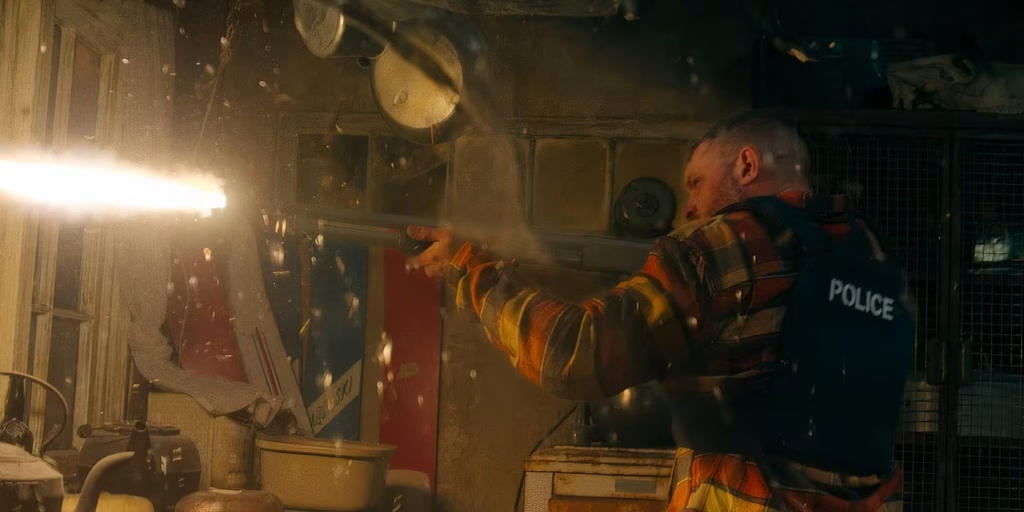
Hardy fits the lone-wolf cop archetype like a bloodstained glove, and his morally grey, almost Shakespearean tragic hero feels instantly mythic as he ducks bullets and bodies, still clawing for the right thing in a wrong world. Usually in a crime saga like this, the lead would be a hitman or a gangster with a bruised conscience, but Evans raids a different armory, pulling from classic rogue-cop tales like Serpico and Heat, and recasts Walker as the classic maverick detective. He’s part of a tight-knit crew of cops robbing the criminals blind—skimming drugs and cash—while serving a high-level puppet master, a megalomaniac businessman who is filthier than the streets he owns and gunning for the mayor’s office. Of course he is. This time that power-hungry kingpin is Lawrence Beaumont, played with scene-devouring relish by Forest Whitaker, who clearly revels in the role of a snake who just might sprout a conscience by the end. But make no mistake: Hardy’s Walker is in full crisis-of-faith mode, cut off from most of his department, including a former ally turned icy threat, played with steely menace by the ever-game Timothy Olyphant. Walker’s one semi-ally is Officer Cheung, played by Jessie Mei Li, forced to ride shotgun with him on this Christmas Eve shift from hell, just as everything goes spectacularly, catastrophically wrong.
On paper, there is nothing remotely original about this setup; the plot is basically a skeleton built to hang bullet-riddled set pieces from. And that is fine, because when the film slams into its final act, the bullets and blood don’t just fly—they detonate. The extended, sense-pummeling action onslaught does exactly what it is engineered to do. The last forty-five minutes are a massacre marathon, a blunt-force-trauma showcase of stunt design and ballistic chaos—and that’s still underselling it.

Walker’s night nosedives almost immediately when he’s ordered to run a rescue op for Beaumont’s son, an idiot rich kid who thinks cutting a deal with the Triads is a smart move. It isn’t. The meet explodes into a gunfight as mystery shooters crash the party. When the smoke clears, the son of a notorious crime lord is a chalk outline, and Beaumont’s boy is suspect number one. Every cartel, crew, and trigger-happy psycho in the city wants a piece of him and his unlucky girlfriend. Add Olyphant’s death-squad cops and his burning need to permanently silence Walker, and you’ve got the blueprint for a finale that is absolutely riddled—and yes, truly riddled—with bullets, the kind of climactic bloodbath people will talk about in hushed, gleeful tones.
The curse and blessing of Evans’ own work is that the Raid films are such flawless masterclasses in modern action that everything he does now—and everything other directors do in the genre—gets judged against them. Fans need to holster those expectations a bit. Not every movie is built to hit those stratospheric heights, and if you can accept that, you might find yourself enjoying something like Havoc on its own feral terms just as much.
It’s fair to say Havoc is every bit as violent as The Raid and its sequel, but that doesn’t mean it’s trying to clone them. Havoc is its own rabid animal, built different by design, and Evans is clearly paying top-tier tribute to the glory days of Hong Kong action and the heroic bloodshed tradition forged by directors like John Woo. If you follow me or any self-respecting action outlet, you probably don’t need a primer—but here’s one anyway. Heroic bloodshed is the label slapped on that run of late-80s and early-90s films orchestrated by Woo and Lam where bullets were as cheap as oxygen. The leads were damaged heroes or anti-heroes, icons like Chow Yun-Fat, men who weren’t saints but still shouldered the weight of doing the right thing, mowing down armies with enough firepower to start a small war. When they got hit, they barely flinched—grimacing, powering through like human tanks—and when they finally went down, it was operatic, drenched in slo-mo and pathos, the kind of thing that would make Zack Snyder squeal. Many films have tried to bottle that lightning since, but here Evans empties the clip: polishing his own monument to bullet storms and blood buckets, succeeding in fits and bursts. One thing’s certain—you’ll be hard pressed to find an action flick this trigger-happy, and heroic bloodshed devotees will feast on that last 45-minute stretch.

Visually, Evans frames Havoc like a living graphic novel, painted in neon wounds and hard blacks, staged in a cityscape ripped straight out of a Frank Miller panel. The nameless city becomes a character—sweating despair, reeking of bad choices. Shot after shot begs to be paused, printed, and pinned on the wall like splash pages torn from an over-the-top crime comic. Even the muzzle flashes have style—bright orange and yellow bursts that slice through the filthy darkness, illuminating this ballet of bullets and bloodshed. If this weren’t such a carnage-drenched hell ride, it might even be called beautiful; instead, the stylized flare becomes a brutal reminder of the endless casualties piling up in the frame.
Cinematographer Matt Flannery drowns the film in a dark, dank, unforgiving look that rips it away from the slick, polished glass of franchise fare like the John Wick series. This is the other side of the coin—grimy, soaked in sweat, dirt, and cordite. The sound design becomes its own firing squad: every gunshot kicks like a live round, echoing old-school carnage from Sam Peckinpah and Walter Hill. It’s loud, immersive, and teeth-rattling, a sonic beatdown that practically demands an IMAX screen; the living room just can’t handle this kind of impact. Each weapon seems to have its own signature roar, so you always know who’s pulling the trigger when the mayhem hits full volume.
And then there’s Tom Hardy. This guy can play shattered tough guys in his sleep, but Evans doesn’t let him coast—he drags Hardy through the grinder for more than half the runtime. Hardy, for his part, seems to love it; he soaks in every second of filth, sweat, grime, and blood, as if daring Evans to crank it up even more. Fans might come in expecting the silky, surgical Penkak Silat artistry of Iko Uwais from Evans’ past work, but here Hardy is deployed like a battering ram. The fights are pure blunt-force trauma to skull and ribcage. Walker is no elite martial artist; he’s just a tough cop who knows how to brawl dirty, and his combat style is as ugly as it gets. Faces smash into floors, dropkicks land with Rowdy Roddy Piper-level nastiness, and literally anything not bolted down becomes a weapon. Hardy’s Walker kills with maximum prejudice—and there are more than enough enemies here to test his stamina.

Hardy’s secret weapon, as always, is what he does when he’s not talking. Like in so many of his roles, he communicates through micro-shifts in expression; whole character arcs flicker across his face without a line of dialogue. The final shot of the film is proof enough—no spoilers, but the last image of Hardy lingers, haunting and oddly tender at the same time. Like Jason Statham, he’s a blue-collar action star, the kind who’s willing to get filthy and wreck his body in the name of the craft.
The supporting cast holds the line with what they’re given, but there are casualties on the character front. Timothy Olyphant’s ultra-crooked cop Vincent, in particular, deserves more screen time and more dimension. Olyphant is a precision actor, and here he’s stuck mostly hitting a single note as a one-track antagonist. He’s good—he’s always good—but the script only hands him a few beats amid the carnage. A deeper buildup between Vincent and Hardy’s Walker would have made the final confrontations hit even harder.
Jessie Mei Li is strong as Ellie, the honest rookie thrown headfirst into this night of escalating violence when she’s paired with Walker. Li plays her as a fresh-faced, idealistic officer who gets tossed in the blender and comes out the other side hardened, forced to decide whether she’ll stand up and do the right thing or look away like everyone else.
Justin Cornwell’s Charlie, Beaumont’s son, is the spark that ignites all this havoc, and his girlfriend Mia, played by Quelin Sepulveda, has more to do than just scream and run. Yes, they’re victims of their own bad decisions, but they’re not just mice spinning in someone else’s maze; they step up and get their hands dirty once the bullets start flying. Sunny Pang, a familiar face from Evans’ earlier work, shows up as a Triad player bitter about being passed over for the throne. He doesn’t get as physical this time around, but he still contributes to the movie’s ever-growing body count.
And then there’s Forest Whitaker. What’s left to say about an Oscar-caliber actor who never phones it in? Even with limited screen time, Whitaker layers Beaumont with quiet menace and slow-bleeding nuance, playing a sleazy businessman who’s in it for himself but starts to wobble as the final showdown approaches.

Now for the meat of the matter: the set pieces and action design. If you came for wall-to-wall chaos, you’ll have to be patient; Evans loads the chamber slowly. There’s an opening car-and-truck chase that feels ripped from a high-octane video game—stylized, kinetic, and packed with practical crunch. After that, the movie tightens the screws as Hardy’s Walker staggers through the fallout. But once the movie hits the forty-five-minute mark, Evans floors it. From there, it’s full throttle, no brakes, no mercy, all the way to the final frame.
The first real barrage detonates in a nightclub, where Evans finally cuts the safety and lets the stunt team and cast raid the dance floor. We’ve seen club fights before, but here the carnage feels especially raw and savage—ugly in all the right ways—yet surgically crafted for maximum impact. Evans’ handheld camera work swirls through the chaos, enhancing the insanity without ever losing clarity; the action choreography still reads clean and hits hard. Hardy is pure beast mode in this sequence, fighting with a “whatever works” mentality, grabbing, smashing, and breaking anything and anyone between him and survival.
The grand finale stages its massacre at Walker’s old family cabin, buried deep in the woods, and this is where Evans and crew fully unload their homage to heroic bloodshed. The staging, rhythm, and framing all scream vintage, bullet-soaked Hong Kong—the sort of bullet ballet where you half-expect white doves to explode across the screen in slow motion. Endless gunfire rips through the night, turning the cabin into a slaughterhouse as bodies drop in stacks. Evans leans into classic heroic-bloodshed slo-mo, never letting it go full parody but using it just enough to throw exclamation points on the worst of the carnage. Honestly, if he’d dressed a few bad guys in crisp white just to showcase the over-the-top blood spray like the climax of Woo’s The Killer, it would have been the perfect cherry on this gore-drenched sundae. Even without that, every spray of red is fully visible, every time someone gets shredded—and there is a lot of shredding.

What pushes the climax into the realm of outrageous is Hardy’s improvised arsenal. Walker turns the cabin into a medieval torture playground: blades, hooks, shards of glass, splintered wood, and more all get their moment to maim. Kill after gnarly kill hits the screen, and while it’s vicious, it’s also pure, old-school action catharsis—the kind of brutal creativity that makes fans cheer instead of flinch.
So was the long wait for Havoc worth it? Absolutely. Is it perfect? No—and no movie is, because “perfect” lives in the eye of the beholder. People can anoint any film a masterpiece, but at the end of the day it’s all opinion. Here, even with nitpicks about thin characterization and some clumsy dialogue, Evans grabs this film by the throat and makes it his own, all while saluting the action filmmakers and movies that made him. He knows this genre inside out, and Havoc is the closest thing we’re likely to get to the heyday of Hong Kong cinema, when safety regulations were an afterthought and the only thing that mattered was the shot and the impact. This is stripped-down, bare-bones, catastrophic, mind-numbing gore, violence, and action design in its rawest form. It’s the proverbial kitchen sink—and then some—hurled at the audience, and it fires on all cylinders, ready to satisfy even the most battle-hardened action fan.
Tom Hardy once again owns every frame he’s in; even when his character is deeply compromised, you’re wired to root for him. There are no clean heroes here—just shades of bad and worse—and Evans never apologizes for the scorched-earth world he’s built. This is a single night of unrelenting chaos, filtered through Walker’s eyes, unfolding on what should be the most peaceful evening of the year. The ensemble steps up with what they’re given; and while some players clearly deserved more screen time and development, they still make their moments count when the camera swings their way.
Havoc delivers exactly what it promises. It’s a full-bore homage to Hong Kong heroic bloodshed, a direct line from the bullet ballets of the 80s. A savage portrait of the worst instincts of men and the rot in humanity. A clean, brutal descent into hell with no redemption waiting at the bottom. If you live for action cinema—and especially for horror-level, unflinching violence—this is squarely in your kill zone. When you fire this one up on your Netflix queue, you know exactly what mission you’re accepting, and Gareth Evans, Tom Hardy, and the entire cast and crew throw every drop of their blood, sweat, and tears at the screen to entertain you. You’ll either love it or hate it, and I’m firmly in the first camp. Now, can we have The Raid 3, please and thank you.

VERDICT: 4 Out of 5 Stars
Gareth Evans roars back with a gloriously hyper-kinetic, hyper-gory love letter to classic bullet ballets, a blunt-force-trauma experience that never overstays its welcome and delivers exactly the carnage we came to see.


