0
 0
Catching up on some of my must-see action flicks that slipped past me on release, I found that some movies kick down the door with guns blazing. Hunting Season doesn’t. It creeps up on you — quiet, patient, and coiled tight like a trap waiting to spring. Mel Gibson headlines as Bowdrie, a hardened survivalist living off the grid, and the result is a tense, atmospheric thriller that trades nonstop explosions for something more primal: dread, isolation, and the terrifying cost of being found. Every creak of timber, every long shadow stretching across the tree line, every silence that lingers a beat too long works like a slow-tightening noose. This is a film that understands the wilderness itself can be a weapon, and it uses that isolation to keep you leaning forward, waiting for the moment the quiet finally breaks.

The Setup: A Quiet Life Turns Violent
Heads up, action junkies: this section is a spoiler-light plot rundown, so expect broad strokes rather than specifics. Hunting Season opens deep in the wild, where Bowdrie and his teenage daughter Tag have built a life entirely off the grid. There’s no safety net out here — just traps to check, supplies to ration, weather to read, and a hard-earned rhythm born from years of practice. Bowdrie has drilled Tag in everything he knows: tracking, survival, self-defense, the instincts needed to vanish and endure. It’s a hard existence, but it’s theirs, carved out of isolation and discipline, and for a while the film simply lets us live in it alongside them.
That fragile equilibrium shatters when Shelley Hennig’s January turns up on their doorstep, bloodied and barely standing, having narrowly slipped free of a ruthless cartel determined to drag her back. Her arrival rips the door wide open on the dangers Bowdrie has spent years trying to outrun, and suddenly the skills he’s hoarded for his own survival become the only thing standing between his family and annihilation. What begins as an act of mercy — taking in a wounded stranger — quickly spirals into something far more perilous, as the cartel’s reach begins closing in on the homestead itself.

From there, Hunting Season shifts from intimate survival drama into a tense, high-stakes manhunt. Bowdrie and Tag are forced to use every ounce of their off-grid expertise not just to hide, but to actively fight back, as the threat tightens scene by scene rather than arriving all at once. Without giving away how things ultimately shake out, the back half of the film escalates into a full-blown rescue mission, with father and daughter going on the offensive to protect January and keep their fractured little family intact. It’s a ferocious, hard-earned payoff — and exactly the kind of slow-burn-to-explosion plotting that makes this one worth watching for yourself.
Gibson’s Best Role in Years
Let’s not bury the lede: Mel Gibson is perfectly cast here. As Bowdrie, he channels an older, battle-scarred echo of Martin Riggs — the same wild-eyed intensity, but weathered down by years and solitude into something quieter and more dangerous. This isn’t a man chasing adrenaline anymore; it’s a man who has built a fortress of silence around himself, and Gibson plays every ounce of that hard-won stillness with total conviction.
Whatever you make of Gibson’s well-publicized personal issues — and this is not a defense of his conduct — his Hollywood star may have tarnished, but he still never phones in a performance. He remains a commanding screen presence, bringing lived-in gravitas, physical authority, and a dangerous intensity to Bowdrie. That is a point about the work on screen: the force of the performance, not a free pass for the man behind it. Watch how he carries himself — the stooped shoulders, the deliberate movements, the eyes that scan a room before his feet ever cross the threshold.

It’s a physical performance as much as an emotional one, every gesture suggesting a lifetime of violence he’s trying to outrun. There’s gravitas in his silence, a sense that danger is coiled just beneath the surface, banked but never extinguished. When the chaos finally arrives, you believe every violent, desperate thing he does to protect what’s his — because Gibson has spent the entire runtime convincing you that this is a man who has already buried the person he used to be, and will dig him back up without hesitation if it means keeping his daughter alive.
Sofia Hublitz Is the Heart of the Film
Opposite Gibson, Sofia Hublitz delivers a quietly powerful performance as Tag, Bowdrie’s daughter, and together their father-daughter dynamic becomes the emotional spine of the film. Raised almost entirely off the grid, Tag knows little of the outside world beyond what her father has taught her — how to track, how to survive, how to disappear — and every one of those lessons is really about one thing: how they keep each other alive. Beneath the survival drills, the guarded silences, and the harsh, no-frills existence is a complicated bond built on loyalty, dependence, and a fierce sense of protection forged by shared history. Hublitz brings a watchful, guarded intelligence to the role, making Tag feel like a kid who’s been handed an adult’s burden and carried it without complaint, but also a daughter who still, deep down, needs her father.

Her vulnerability and her steel both trace straight back to Bowdrie — she’s tough because of him, but the cracks in her armor are his, too. And for Bowdrie, every decision suddenly hits harder because it’s not just about staying ahead of the threat; it’s about keeping Tag breathing, giving his choices a bruised, human weight that makes you actually care what happens to them. This isn’t a damsel waiting to be rescued — Tag is capable in ways that matter, her father’s lessons etched into her reflexes and instincts rather than just her memory, and it’s that mix of hard-won skill and fragile humanity that keeps the stakes feeling sharp.
She reads terrain the way other teenagers read a phone screen, and there’s a quiet competence to her that makes clear she’s been training for a moment like this her entire life, even if she never wanted to believe it would come. That competence is tangled up with real emotional weight, too: Tag loves this harsh, isolated life even as it’s clearly cost her a normal childhood, and Hublitz lets both truths sit side by side without ever resolving them neatly. She’s not just along for the ride; she’s the emotional center that gives Bowdrie’s grim world its stakes.
A Slow Burn That Earns Its Fire
Make no mistake: Hunting Season takes its time, and that patience is a feature, not a flaw. The first two-thirds of the film settle into the rhythms of Bowdrie and Tag’s isolated life, letting us feel the weight of the wilderness around them and the unspoken history between father and daughter. We watch them check traps, ration supplies, read the sky for weather, move through their routines with the wordless efficiency of two people who’ve done this a thousand times before.
It’s a deliberate, patient build — more character study than action spectacle — and every quiet scene is doing real work, stacking detail upon detail until this isolated homestead feels lived-in and real, until the bond between Bowdrie and Tag feels earned rather than assumed. That groundwork matters, because dread needs something to threaten before it means anything. By the time the plot turns, you’re not just watching strangers in danger — you’re fully invested in this fractured little family and the fragile peace they’ve carved out for themselves, and that investment is what makes everything that follows hit as hard as it does.

Everything Changes When Shelley Hennig’s January Washes Up
That fragile routine shatters the moment Shelley Hennig’s character of January stumbles onto Bowdrie’s doorstep, badly injured and running from a ruthless cartel hot on her trail. From here, Hunting Season shifts gears hard. The isolated homestead that once felt like sanctuary becomes a battleground, and Bowdrie’s carefully hoarded survival skills — the same ones he’s spent years teaching Tag — are suddenly the only thing standing between his family and annihilation. Hennig brings a raw, desperate urgency to her role that lights the fuse on everything that follows, and the escalating sense of dread that’s been building since the opening frame finally has somewhere to go. The film doesn’t rush this transition, either — it lets the threat close in gradually, tightening the screws scene by scene, so that when the violence finally arrives it doesn’t feel like a tonal whiplash but the inevitable payoff of everything that came before.
A.J. Buckley Makes a Convincingly Dirty Cop
Among the film’s standout supporting turns is SEAL Team’s A.J. Buckley as a crooked cop whose badge only makes him more dangerous. Buckley doesn’t lean on cartoonish sneering or scenery-chewing to sell the character’s corruption — instead, he plays it cool and controlled, letting the menace simmer underneath a veneer of procedural authority. That restraint is what makes him work. There’s an unsettling believability to the way he wields his position, using the trust people place in a uniform as a weapon, and Buckley never overplays his hand. You get the sense this is a man who has crossed this line before and will cross it again without losing a wink of sleep over it. It’s a performance built on quiet threat rather than theatrics, and it lands every time he’s on screen.
Jordi Mollà’s Wild, Woozy Alejandro
Jordi Mollà turns in a serviceable performance as Alejandro, the film’s vile cartel heavy, and he makes sure you feel the character’s cruelty from the moment he arrives. Alejandro is a genuine threat — casually brutal, entirely unpredictable, the kind of villain whose presence alone raises the temperature of every scene he’s in. What’s most memorable about Mollà’s take, though, is the strange, loose energy he brings to the role. He plays Alejandro with such a woozy, unsteady swagger that the character seems almost perpetually intoxicated, weaving through scenes with a dazed, off-kilter looseness that makes him feel even more volatile and harder to predict. To be clear, that’s a read on the performance choice and the impression it leaves on screen, not a comment on Mollà himself — but it’s a distinctive, memorable flavor of menace that sticks with you.
The Slow Burn Erupts Into a Ferocious Shootout
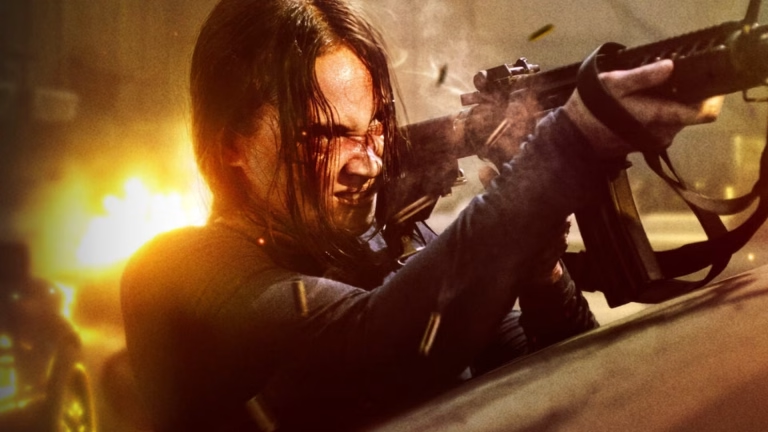
All of that patient, tightening dread finally snaps in the film’s back half, when Bowdrie and Tag go on the offensive against the cartel to rescue January. The tonal release is sharp and immediate — one moment you’re sitting in tense, quiet dread, and the next you’re thrown headlong into a chaotic, bloody shootout where every bullet feels like it matters. This isn’t slick, choreographed action for its own sake; it’s desperate, survival-driven violence, the kind that comes from two people with nothing left to lose fighting for someone they love. The lawn-mower torture sequence that precedes it is especially effective at revving the film’s engine for the finale. Its grim escalation pushes the tension into a higher gear, making the cartel threat feel immediate and vicious without tipping into graphic procedural detail. More than a shock beat, it primes you for the bloody reckoning to come, turning all that slow-burn dread into something suddenly hot, urgent, and impossible to ignore — without giving away where the story ultimately lands.
The chaos is disorienting in the best way — bodies move fast, plans fall apart, and the stakes never let up for a second. And right in the middle of it, Gibson taps back into something unmistakably familiar: that reckless, lethal unpredictability he carried as Martin Riggs decades ago. This isn’t a copy of that performance — it’s an older, grizzled, battle-worn version of that same spark, a man who has buried that wildness for years finally letting it loose when it counts. The payoff is as emotional as it is explosive, because by this point you’re not just watching a shootout — you’re watching a father prove, in the most brutal way possible, exactly how far he’ll go for his family.
The Verdict
Hunting Season is a patient, atmospheric thriller that rewards viewers willing to sit with its slow burn before it detonates into full-blown survival carnage. Without spoiling specifics, the back stretch delivers exactly the kind of brutal, cathartic eruption this slow burn has been quietly engineering — righteous fury unleashed by a man who’s spent the whole film holding it back, violent retribution that feels earned rather than gratuitous because of everything we’ve learned about who Bowdrie is and what he stands to lose.
Gibson is riveting as a grizzled loner forced back into the fight, Hublitz grounds the film with real emotional stakes and proves herself more than capable when the moment demands it, and Hennig’s arrival ignites a third act that hits like a gut punch. If you want wall-to-wall explosions, look elsewhere — but if you want tension that simmers before it scorches, and a payoff that feels like justice rather than spectacle, Hunting Season absolutely delivers. Highly recommended.
Action-Flix Rating: 3.5 out of 5 stars
Load up, lock in, and let Hunting Season unleash its grizzled brand of frontier fury.