

 0
 0
The King of the Monsters Returns to His Throne.
With the sequel stomping into theaters next week, it feels like the last possible moment to rectify a minor personal crime: I never gave Godzilla Minus One the proper review it deserved. That failure feels especially egregious coming from someone who’s been a massive Godzilla fanatic for decades, ever since childhood Saturday matinees first burned the King of the Monsters into my brain — and because Godzilla Minus One isn’t just my favorite Godzilla movie, it’s one of the sharpest reinventions the series has ever seen. So, before the next chapter detonates, forget everything you think you know about monster movies.
Godzilla Minus One isn’t just a creature feature — it’s a harrowing character drama that uses kaiju terror to excavate the emotional ruin of post-war Japan. Writer-director Takashi Yamazaki strips away nostalgia and bombast to rebuild Godzilla as an existential crisis made flesh, and he does it by binding every roar and blast of atomic breath to the shattered psyche of one man and the fragile healing of a nation.
What begins as a story of a disgraced pilot’s cowardice spirals into a devastating portrait of trauma, survivor’s guilt, and the desperate, stubborn will to live. This is essential viewing for anyone who cares about what blockbuster cinema can say — and how hard it can hit — when it refuses to treat destruction as empty spectacle.

Story and Themes
Set in the immediate aftermath of World War II, the film centers on Kōichi Shikishima (Ryunosuke Kamiki), a kamikaze pilot who abandons his assigned suicide mission mid-flight, diverting his damaged Zero to Odo Island rather than completing the attack. When Godzilla assaults the island that night, Shikishima freezes at the controls of the base’s 20mm anti-aircraft cannon, unable to fire even as the creature slaughters the maintenance crew around him. This failure isn’t a throwaway backstory beat — it becomes the film’s central wound. Every major choice he makes, from returning to a bombed-out Tokyo to building a makeshift family, is haunted by the knowledge that he lived while better men died because he could not act.
Yamazaki braids themes of survival, shame, and moral responsibility through this narrative: Shikishima is not guilty in the legal sense, but he feels complicit in his comrades’ deaths and in the larger machinery of a war that chewed up lives. The film’s central question isn’t whether humanity can defeat Godzilla, but whether someone as broken as Shikishima can ever believe he deserves to survive — and what “redemption” might even mean in a landscape where survival itself feels like theft.

Performances, Characters, and Emotional Arcs
The human ensemble is where Godzilla Minus One cuts deepest, and Yamazaki trusts his actors to carry the film’s heaviest philosophical and emotional weight. Ryunosuke Kamiki’s performance as Kōichi Shikishima is quietly shattering: he plays the character not as a traditional heroic lead but as a man constantly flinching from his own existence. His eyes do most of the work — hollow in the early scenes, darting and unfocused when Godzilla resurfaces, and gradually, painfully clearing as he begins to accept that the life he’s building is real and therefore vulnerable.
Kamiki makes Shikishima’s guilt tangible in small physical choices: the way he hesitates before entering his makeshift home, as if he’s trespassing on happiness he doesn’t deserve; the instinctive flinch when children laugh, because joy feels like a rebuke to his survival; the near-panic that overtakes him whenever the possibility of another attack creeps in. His arc isn’t about becoming fearless; it’s about learning to act despite terror and self-loathing, and the film’s climax only lands because Kamiki sells every stage of that progression. Sakura Ando’s Sumiko Ōta, Shikishima’s embittered neighbor, provides the film’s sharpest emotional counterpoint. Having lost her entire family in the Tokyo firebombing, she initially greets Shikishima’s survival with open contempt, blaming him and men like him for a war that orphaned her and left her raising a child that isn’t hers. Ando plays that anger without softening it into easy forgiveness — her scorn is specific, personal, and earned, and it forces Shikishima to sit with the consequences of his choices rather than simply move past them.
What makes her arc so affecting is how gradually it turns: hostility curdles into grudging cohabitation, then reluctant cooperation, and finally something like trust, as she comes to see Shikishima not as a symbol of wartime cowardice but as a man trying, clumsily and sincerely, to build a family out of wreckage. Ando never oversells the shift — it’s communicated in small softenings of posture and tone — and it gives the film one of its most quietly devastating relationships.

Godzilla: Presence, Symbolism, and Terror
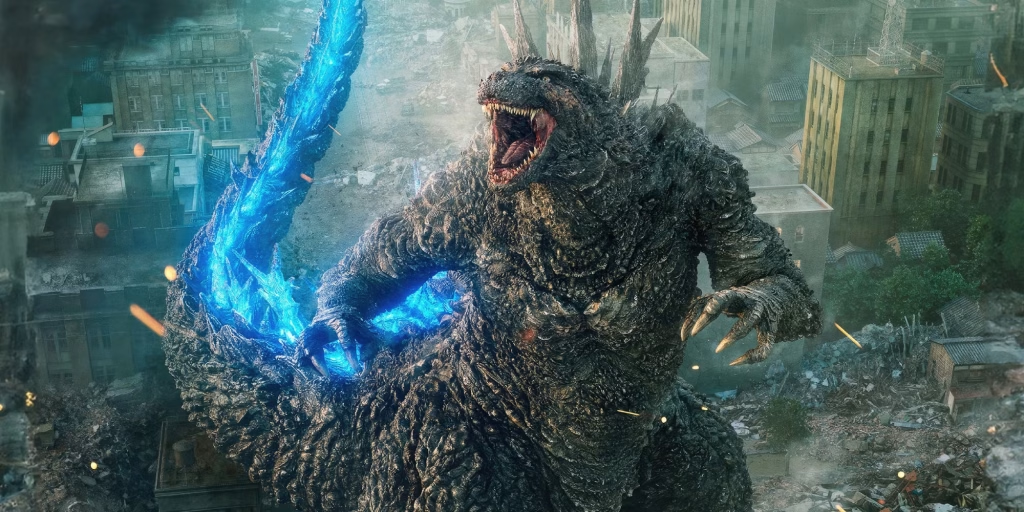
Yamazaki’s Godzilla is less a character than a recurring, inescapable catastrophe, and that’s precisely what makes him unforgettable. Physically, this Godzilla is brutalist horror: his jagged dorsal plates jut like charred rebar from a bombed-out cityscape, his skin looks scorched and fissured, and his bulk feels unnervingly heavy in every step. The design refuses sleekness; he’s not an action figure, he’s a radiation-burned wound walking on two legs. The film never gives Godzilla explicit motivation, and he isn’t written as a creature with personal malice toward Shikishima — but it’s hard not to read symbolic intent into the way his reappearances keep landing on moments when humans start to rebuild, as if fate itself were correcting what the war failed to finish.
His first attack on Odo Island plays like a savage prologue, but it’s the Ginza sequence where Yamazaki fully weaponizes Godzilla’s presence: long, dread-filled build-up, then the horrifying spectacle of his dorsal plates charging like a reactor about to breach. When he unleashes that atomic heat ray, the film momentarily abandons the language of monster movies and slips into pure disaster horror — buildings vaporized in an instant, bodies and streets swallowed by incandescent annihilation.
Symbolically, he collapses multiple traumas into one being: nuclear devastation, militaristic hubris, and the arbitrary cruelty of survival. The film never lets Godzilla become mere spectacle because every appearance reopens emotional wounds; he’s an overwhelming force that dwarfs human agency, and the suspense he generates isn’t “will they win” so much as “what will be left of these people if they somehow do.”

Action, Suspense, and Emotional Impact
The action in Godzilla Minus One is constructed as a series of escalating psychological tests rather than simple set pieces. The Odo Island attack is pure panic, introducing Godzilla as incomprehensible force and permanently branding Shikishima’s psyche. The Ginza devastation reframes that panic as systemic failure: the authorities underestimate the threat, civilian defenses prove hopelessly inadequate and are overwhelmed within moments, and the city is reduced to ash in seconds. Yamazaki shoots the sequence with a horror director’s patience — empty streets, distant rumbles, people looking upward in confusion rather than instantly screaming — so that when Godzilla’s breath wipes out entire blocks, the shock registers not only as visual spectacle but as a moral indictment of post-war complacency.
Later, the maritime confrontations shift the suspense into almost procedural territory: men on retrofitted civilian vessels, improvising tactics because the American military won’t intervene directly, caught as it is in the brewing tensions of the emerging Cold War — Washington is wary of provoking the Soviet Union with a show of force so soon after the war’s end, and the Japanese government, still gutted and distrustful of its own disbanded military, refuses to acknowledge its vulnerability publicly. Every torpedo launch and cable deployment is crosscut with faces contorted in fear and determination, grounding the action in individual decisions rather than anonymous CGI chaos. The emotional impact peaks because these battles never feel like abstract ‘humanity vs monster’ showdowns; they feel like the last gambles of people who’ve finally decided that living with permanent terror is worse than risking everything on one impossible plan.
The climactic Operation Wadatsumi — using pressurized air bladders to drag Godzilla into the depths and then rapidly decompress him at the surface — isn’t real science; it’s the film’s own invention, dressed in just enough technical jargon to feel plausible within its story. What makes the sequence resonate, though, is what happens aboard Shikishima’s Shinden fighter. Believing he’s finally found his chance at a meaningful death, Shikishima straps in to ram Godzilla’s exposed jaw with an onboard bomb — only to discover, in the cockpit, that his mechanic, Sōsaku Tachibana, has secretly installed an ejection seat. Shikishima ejects seconds before impact and survives, and the moment lands as a direct rebuttal to the wartime ideology that demanded his death as proof of devotion: survival, not sacrifice, becomes the film’s final act of defiance.
The epilogue delivers one more gut-punch and one more flicker of hope. Noriko, presumed dead after collapsing during the Ginza attack, is revealed to have survived and is shown recovering in a hospital bed, where she’s reunited with Shikishima and Akiko. A dark mark pulses on her neck, and the film never confirms what it means — but set against the final shot of Godzilla’s severed flesh regenerating on the ocean floor, it reads as an ominous implication that whatever force let him heal might be spreading inside her too. It’s a refusal of easy closure: that last glimpse of Godzilla strongly implies he survived the attack, and Noriko’s mark suggests humanity’s victory is far from total.

Historical Context
From its opening frames, Godzilla Minus One is steeped in the ruins of history. By situating the story in 1945–47, Yamazaki returns the franchise to the conditions that birthed the original 1954 film: a nation gutted by war, haunted by atomic trauma, and struggling to reconcile individual suffering with collective responsibility. Shikishima’s status as a failed kamikaze is crucial — he embodies the cruelty of a system that demanded his death as proof of loyalty and then left him alive, spiritually unmoored and socially suspect.
The film quietly depicts the social tension of the period: veterans unable to find work, civilians bartering for scraps, the black-market economy emerging in the absence of functioning institutions. It’s worth noting that Yamazaki takes clear historical liberties here — the real Allied occupation of Japan was far from hands-off, yet the film keeps it almost entirely offscreen so the story can stay focused on ordinary civilians forced to solve an impossible problem themselves. Godzilla becomes both a byproduct of nuclear experimentation and a metaphor for what the nation refuses to face head-on: its own role in the war, the exploitation of its citizens, and the unresolved grief of the survivors. When ordinary civilians and veterans ultimately band together to confront Godzilla with jury-rigged technology, it plays not as nationalistic triumph but as a grassroots attempt to reclaim agency in a country where official channels have failed them.

Why It Stands Out Among Modern Kaiju Films
Where many modern kaiju blockbusters race toward novelty and bigger spectacle, Godzilla Minus One commits to emotional specificity. It keeps its cast small, its perspective grounded, and its stakes fiercely personal, so the global implications of Godzilla’s existence are always refracted through the trauma of people we know by name. The film understands that awe without grief feels weightless: Godzilla’s appearances are terrifying not only because of the destruction they bring, but because they threaten the fragile pockets of normalcy Shikishima and others are trying to nurture.
Yamazaki sidesteps the franchise’s tendency toward monster-versus-monster escalation and instead returns to a more intimate, almost claustrophobic tone — the sense that nowhere is truly safe, not because another titan might show up, but because one is more than enough. That restraint, combined with the film’s refusal to grant easy heroism or tidy closure, gives it a moral clarity most modern entries lack. It doesn’t just remember what Godzilla used to represent; it reinterprets that legacy with a precision and seriousness that make almost every recent kaiju outing look frivolous by comparison.

The Verdict
Godzilla Minus One is a rare blockbuster that fuses intimate psychological storytelling with apocalyptic spectacle, leaving its characters — and the audience — scorched but not entirely hopeless. Ryunosuke Kamiki’s portrayal of Kōichi Shikishima anchors the film in raw, unflinching guilt and hard-earned courage, while Minami Hamabe and the supporting cast give that internal struggle something real to lose. Yamazaki’s Godzilla is an unrelenting embodiment of nuclear terror and survivor’s remorse, his every appearance a reminder that some wounds never fully close, only scar over.
The final sequence, with Shikishima’s apparent sacrifice, Godzilla’s freezing and descent, and Noriko’s unexpected survival, doesn’t tidy up the trauma; it suggests that living on after such horror is its own ongoing battle — and its own quiet victory. Whether you come for the monster or the drama, this is one of the most thematically rich, emotionally bruising kaiju films ever made, and a benchmark for what the genre can still achieve when it refuses to look away from the cost of survival.
Stay locked on ACTION-FLIX as the hype detonates—more instant reaction and a full-throttle review of Godzilla Minus Zero are coming the moment it roars into theaters next week.


